
Does a FLAMES Calculator by Date of Birth Work Differently From the Name Version?
Discover whether a FLAMES calculator by date of birth works differently from the classic name game, how birthday compatibility mechanics work, and why results differ.
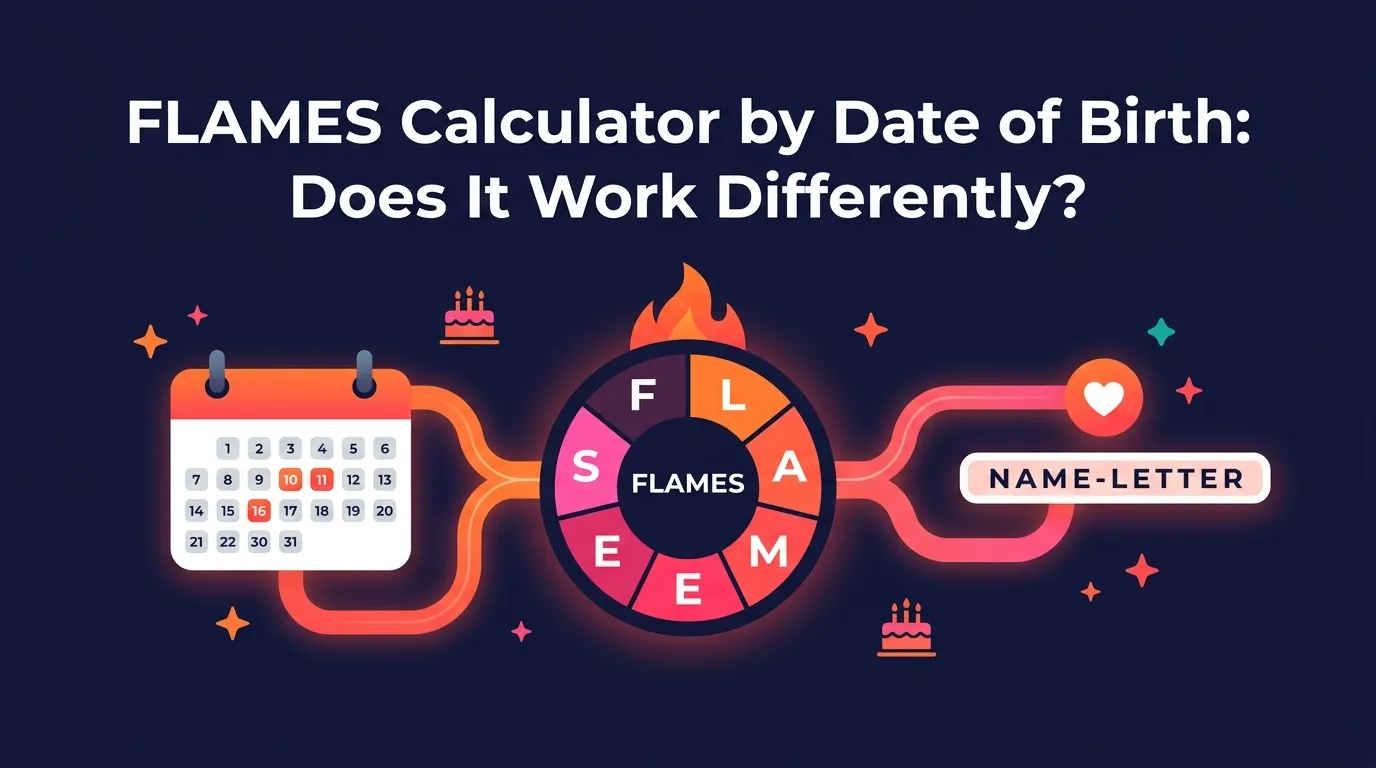
A FLAMES calculator by date of birth is an online relationship compatibility tool and name numerology compatibility calculator that maps calendar birth dates to the 6 classic FLAMES outcomes instead of canceling letters from names. The classic FLAMES game stands for Friends, Lovers, Affectionate, Marriage, Enemies, and Siblings. Many users search for a date of birth (DOB) version of FLAMES to test compatibility without worrying about spelling mistakes, middle names, or nicknames. Exploring a FLAMES calculator by date of birth offers 3 primary benefits: users receive instant relationship entertainment, explore numeric compatibility, and test a method that remains unchanged by spelling variations.
People use a FLAMES calculator by date of birth for 4 primary applications: party games, social media sharing, casual crush checks, and birthday compatibility comparisons with friends. The tool contains 4 main parts: 2 calendar date input fields, a numeric reduction algorithm, a mapping system linking numbers to the 6 FLAMES letters, and an outcome display screen. This guide explains whether FLAMES traditionally uses dates of birth, why some calculators use birthdays, how numeric calculation mechanics work, how name and date versions differ, whether combining methods increases accuracy, and which version users should trust.
Is FLAMES Traditionally Based on Names or Dates of Birth?
FLAMES is traditionally based on names, not dates of birth (DOB). The original game developed as a schoolyard pen-and-paper activity during the 1990s. As explained in the guide to the classic rules, players wrote two full names side by side on paper, crossed out common letters one by one, and counted the remaining letters to eliminate options from the word FLAMES. Calendar birth dates, planetary alignments, and birth years never appeared in the original rules, which operate purely on language and spelling.
Why Do Some Calculators Claim to Use Date of Birth for FLAMES?
Some calculators claim to use date of birth for FLAMES to blend viral game branding with numerology compatibility systems. Website developers recognize that users search for both birthday matchmaking and the famous FLAMES acronym. They apply the recognized FLAMES name to birth date tools to attract search traffic, offering a permanent input value since dates do not change. The inclusion of birth dates represents a modern digital adaptation rather than an authentic rule from the original game.
How Would a Date-of-Birth Version of FLAMES Actually Calculate a Result?
A date-of-birth version of FLAMES calculates a result by reducing two calendar birth dates to single digits and mapping the final numeric value to one of the 6 FLAMES letters. The system replaces letter cancellation with numerological addition. The date-of-birth calculation follows 4 clear mathematical steps:
Step 1: Write both birth dates in numeric format.
A user enters two dates, including day, month, and full year. For example:
- Person 1: 14 July 1998 (14/07/1998)
- Person 2: 22 November 1997 (22/11/1997)
Step 2: Calculate the digit sum for each person.
Add every digit in the birth date until reaching a single digit from 1 to 9:
- Person 1: 1 + 4 + 0 + 7 + 1 + 9 + 9 + 8 = 39 → 3 + 9 = 12 → 1 + 2 = 3
- Person 2: 2 + 2 + 1 + 1 + 1 + 9 + 9 + 7 = 32 → 3 + 2 = 5
Step 3: Combine the two reduced numbers.
Add both single-digit numbers to find the relationship count N:
- Relationship Count N = 3 + 5 = 8
Step 4: Count through the FLAMES acronym.
Count to 8 through F-L-A-M-E-S in circular order, striking out letters:
- Count 1 to 6 lands on S, then cycles back to F (7) and L (8). Letter L (Lovers) is struck out.
- The count continues through the remaining letters until 1 final category survives.
Different websites implement slight variations in step 3 or step 4, yet all date-of-birth versions substitute numeric sums for letter counting. The difference between name-based FLAMES and DOB-based calculators centers on the fundamental input data, the elimination algorithm, and the permanence of the result. Unlike the math behind name-based scoring, DOB tools share no common logic with letter elimination, despite both outputting the 6 familiar labels.
The following table contrasts the 2 methods directly:
| Feature | Name-Based FLAMES | DOB-Based FLAMES |
|---|---|---|
| Primary Input | Alphabetic characters in two names | Calendar birth dates (day, month, year) |
| Core Method | One-to-one letter cancellation | Digit addition and numerology reduction |
| Output Categories | 6 outcomes (F, L, A, M, E, S) | 6 outcomes (F, L, A, M, E, S) |
| Sensitivity to Changes | High (adding a middle name changes the score) | Zero (birth dates remain constant) |
| Mathematical Basis | Discrete letter counting and modulo math | Numerology reduction and circular elimination |
| Historical Origin | 1990s schoolyard paper game | 2010s digital website rebrand |
Name-based FLAMES tests orthographic patterns, whereas date-based FLAMES tests calendar numbers. They represent 2 distinct systems using the exact same acronym.
Can Combining Both Name and Date of Birth Give a “More Accurate” Result?
No, combining both name and date of birth does not produce a more accurate result. Neither name letter cancellation nor birth date numerology holds scientific standing in psychology or relationship science. Adding birth dates to name letters creates a composite algorithm with more variables, but more variables in an entertainment game do not produce empirical truth. Relationship compatibility depends on observable human factors like communication and empathy, not mathematical calculations.
Will You Get the Same Result From a Name FLAMES Test and a DOB FLAMES Test?
None of these relationship pillars exist inside the letters of a name or the digits of a birth date. Enter both inputs into hybrid tools for entertainment, but do not mistake complex rules for scientific measurement. Because the two methods rely on independent inputs that do not correlate, you will rarely get the same result from both. It simply confirms that DOB compatibility is essentially a numerology test using FLAMES branding.
The classic name-based FLAMES version is far more popular and widely used than the date-of-birth version. Millions of people across the world grew up playing the paper-and-pencil name game. The name-based version dominates the internet because of cultural familiarity, instant playability, and standardized logic. The name version remains the definitive standard, while the date version exists as a niche alternative.
Should You Trust a Date-of-Birth FLAMES Result More Than the Name-Based One?
No, you should not trust a date-of-birth FLAMES result more than the name-based one. Neither version provides actionable relationship guidance. Both systems function strictly as recreational pastimes. Treat both tools with a healthy mindset by playing for fun, ignoring negative outcomes, and focusing on real interactions.
If you prefer the authentic, transparent step-by-step letter elimination method, use the free online calculator to test your names the classic way.
Frequently Asked Questions
Does FLAMES originally use date of birth or just names?
FLAMES originally uses only names, not dates of birth. The authentic schoolyard game relies entirely on crossing out shared letters between two written names and counting the remaining characters.
How does a FLAMES calculator by date of birth actually work?
A FLAMES calculator by date of birth works by adding the digits of two birth dates, reducing the sum to a final number, and using that number to eliminate letters from the word FLAMES. The algorithm substitutes calendar math for letter counting.
Can you get a FLAMES result using only birth dates, no names?
Yes, you can get a FLAMES result using only birth dates on sites that support numeric input, but the system is a numerology calculator using FLAMES labels. Traditional FLAMES requires two names.
Is a DOB-based FLAMES test the same as numerology compatibility?
Yes, a DOB-based FLAMES test is the same as a numerology compatibility test that maps the final single-digit score to the letters F, L, A, M, E, or S. The tool applies game branding to standard birth date reduction.
Why do I get different FLAMES results from name vs. date of birth?
You get different FLAMES results from name versus date of birth since the two tests use completely different inputs and formulas. Letter cancellation math shares no statistical connection with calendar digit addition.
Is there an official FLAMES formula that uses birthdates?
No, there is no official FLAMES formula that uses birth dates. The only recognized classic formula uses one-to-one letter elimination between two written names.
Can I combine name and date of birth for a FLAMES calculation?
Yes, you can combine name and date of birth in hybrid online tools, but the combined score remains a recreational number without scientific value. Adding inputs creates a more complex formula without increasing real-world accuracy.
Which FLAMES method is more commonly used online, name or DOB?
The name-based FLAMES method is far more commonly used online than the date-of-birth method. Name calculators represent over 90% of all FLAMES tools on the web.
Is a date-of-birth FLAMES calculator more accurate than the classic version?
No, a date-of-birth FLAMES calculator is not more accurate than the classic version. Neither method possesses scientific validity, meaning both tools serve solely as lighthearted entertainment.

Alex Carter
Creator & Quiz Researcher
Alex is a writer and internet culture researcher specializing in relationship quizzes, compatibility games, and digital nostalgia. Having grown up playing FLAMES in the back of school notebooks, Alex studies how folk games evolve into digital culture.
Read more about our team →More Articles
How Do You Use a FLAMES Calculator for Your Crush, and What Does the Result Mean?
Learn how to use a FLAMES calculator for your crush step by step, what each FLAMES result (F, L, A, M, E, S) means, which names to enter, and whether the FLAMES game predicts your crush's feelings.
How Can Couples Play the FLAMES Game, and What Do the Results Mean for Marriage?
Learn how couples and married partners can play the FLAMES game for fun, what each FLAMES result means for a relationship, fun date-night FLAMES ideas, and whether FLAMES predicts love or marriage compatibility.