
Affection in FLAMES: What 'A' Means and How It Differs From Love
Find out what the letter A means in the FLAMES game, how Affection differs from Lovers and Love in FLAMES, whether A means someone likes you, and how the FLAMES calculation lands on Affection.
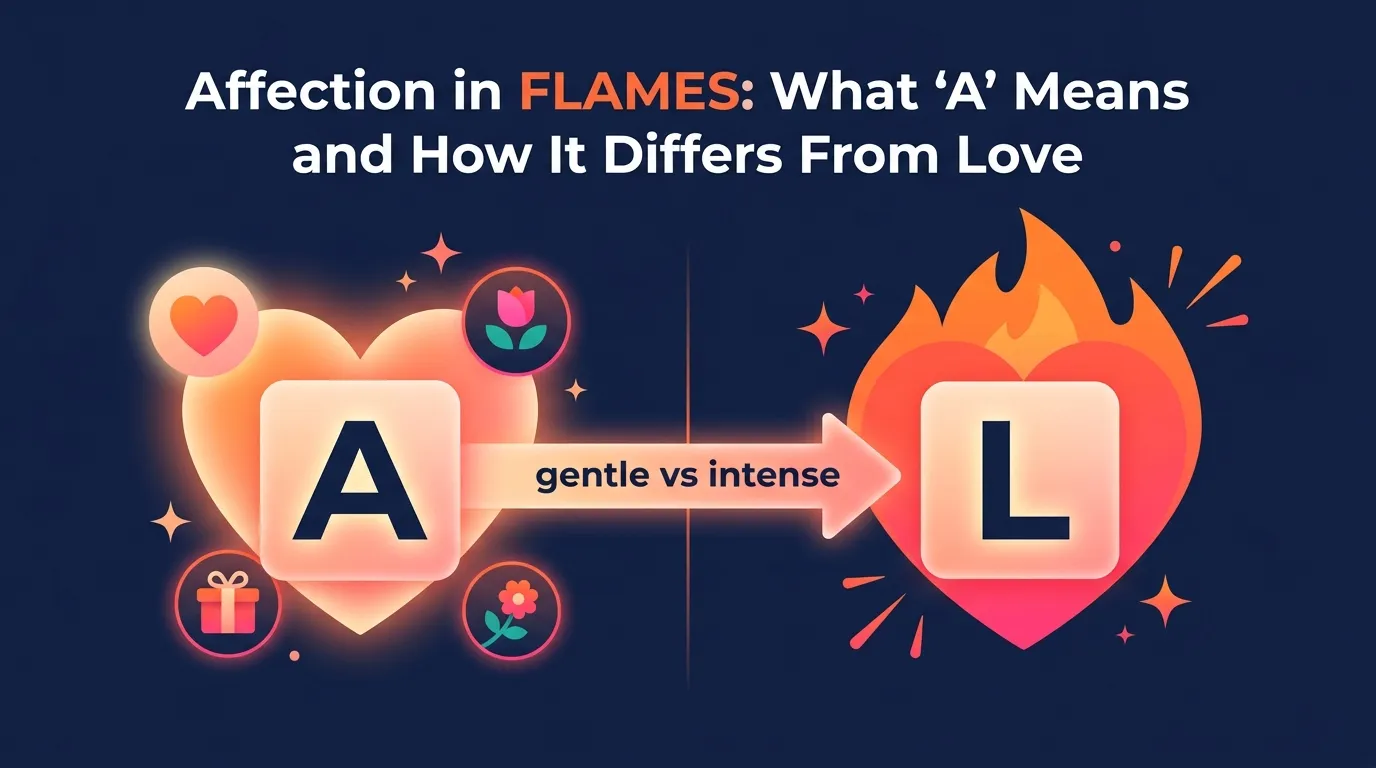
The acronym FLAMES stands for Friends, Lovers, Affection, Marriage, Enemies, or Siblings. It is a letter-counting relationship game that assigns one of six labels based on the leftover characters after cancelling common letters between two names.
The letter A stands for Affection, and landing on this outcome often raises questions about whether it means the same thing as love. This post explains what the letter stands for, how the calculation lands on it, how it differs from the romantic label, whether it means someone likes you, and how it compares with other results.
This label represents the third position in the standard acronym. Because it is the third letter, the game lands on it when the final elimination count stops precisely at position three in the cycle. Some versions of the game use the word Attraction instead, but the underlying numeric calculation process and overall meaning remain exactly the same.
You receive this outcome because the leftover-letter count after cancelling common letters produced an elimination path that ended here. The game uses a fixed counting method, meaning the same two names always produce the exact same result. It relies strictly on arithmetic rather than detecting warmth, tenderness, or genuine liking between two people.
To see how the game lands here, write both names in lowercase and cancel common letters one pair at a time. Count the total remaining letters across both names. Start counting through the acronym in a circle up to that number, and remove the letter you land on. Repeat this process until only one letter remains.
With certain remaining-letter counts, the elimination cycle produces this specific label as the last letter standing. The primary difference between this label and the lovers outcome is simply the name of the category, rather than any actual depth of emotion. The activity does not measure emotion at all, so any perceived difference is entirely based on personal interpretation.
Players often treat the two outcomes differently because of word association. One word sounds like fondness and caring, while the other sounds significantly more romantic. Some players prefer this label because it feels gentler, while others consider the romantic option a stronger result, even though neither is objectively better than the other.
Getting this outcome does not mean someone actually likes you in real life. The label is a game output from a letter-counting exercise, completely disconnected from any signal sent by the other person. The tool saw two names and counted letters, but it did not see two sets of feelings or read body language.
All six possible results are purely mathematical positions in a counting cycle. Getting this outcome with a secret crush feels flattering and fun, but it carries the exact same weight as any other result. It does not confirm mutual feelings, nor does it predict a future relationship between the two names tested.
Real connection comes from talking, listening, and spending time together, rather than letter-counting games designed for school notebooks. The identical two names will always produce the exact same outcome because the label was assigned by a counting formula. You should enjoy the result, share a laugh, and put the game back in the notebook.
Getting this label with a friend, sibling, or partner means the letter count landed appropriately, but the result has no connection to the actual relationship. People receive this label with all kinds of names, including classmates, coworkers, and even absolute strangers. The label does not change anything about a real-world dynamic.
Common real-life reactions to getting this label with an unexpected person usually involve plenty of laughter. Friends might exaggerate caring gestures, while siblings might joke about forced family love. Partners might playfully debate why they didn’t receive the marriage label instead, acknowledging that the activity is played for fun.
Adding one letter to either name can easily flip the result from fondness to friendship, marriage, or any other label. It is purely a counting exercise with zero connection to psychology, relationship science, or compatibility research. Trying a nickname for a different outcome is highly recommended just to see how quickly the prediction changes.
This label, along with Lovers and Marriage, forms the group of three romantic-sounding outcomes in the game. However, the romantic tone of a label does not make the result more accurate or meaningful in reality. The difference between getting a romantic label and a platonic one often comes down to a single letter in one of the two names.
The fixed output from a fixed input means the same two names always produce the same result, yet feelings between people change every single day. The activity collects no information about personality, communication style, or shared interests. No matter what the outcome says, it remains a simple mathematical coincidence that works best as an icebreaker during party games.

Alex Carter
Creator & Quiz Researcher
Alex is a writer and internet culture researcher specializing in relationship quizzes, compatibility games, and digital nostalgia. Having grown up playing FLAMES in the back of school notebooks, Alex studies how folk games evolve into digital culture.
Read more about our team →More Articles
Does a FLAMES Calculator by Date of Birth Work Differently From the Name Version?
Discover whether a FLAMES calculator by date of birth works differently from the classic name game, how birthday compatibility mechanics work, and why results differ.
How Do You Use a FLAMES Calculator for Your Crush, and What Does the Result Mean?
Learn how to use a FLAMES calculator for your crush step by step, what each FLAMES result (F, L, A, M, E, S) means, which names to enter, and whether the FLAMES game predicts your crush's feelings.